Showing posts with label Scriptures. Show all posts

Friday, January 18, 2013

To "go no more out": A textual analysis of a catchy prhase from the Book of Mormon

This morning, I was reading in 3 Nephi 28 and came across the concluding verse, 40, where prophet-historian Mormon describes the translated status of the "Three Nephites," who are previously discussed throughout the chapter:
And in this [translated] state they were to remain until the judgment day of Christ; and at that day they were to receive a greater change, and to be received into the kingdom of the Father to go no more out, but to dwell with God eternally in the heavens.  3 Nephi 28:40
Occasionally, I read certain phrases in the Book of Mormon that really stick with me, like "the way of all the earth," which is used twice in the Old Testament, five times in the Book of Mormon, is preceded in each instance by some form of the verb "go," and refers to upcoming physical death.  Consider this death-bed rejoinder from Lehi to his wayward sons in 2 Nephi 1, for example:
Awake! and arise from the dust, and hear the words of a trembling parent, whose limbs ye must soon lay down in the cold and silent grave, from whence no traveler can return; a few more days and I go the way of all the earth.  2 Nephi 1:14
Returning to what I read this morning, I seemed to remember hearing and reading, on occasion, the first bolded phrase:  "go no more out."  It's another one of those phrases I smile about and like to throw out, myself, every now and again.  For example, perhaps after a long day I've quipped to my wife, "Honey, I'm heading home, to go no more out."

So what does the phrase mean and why am I writing about it, other than because I think it sounds cool?  Well, as with "[going] the way of all the earth," I'm convinced the phrase has a set meaning and context and gives strong circumstantial evidence of the Book of Mormon's veracity.  First, as "going the way of all the earth" is invariably associated with an impending departure from mortality (which all men and creatures experience -- "all the earth"), I believe "to go no more out" subtly refers to our pre-mortal existence with God (or Heavenly Father) and that, once reunited with Him, those who receive this gift of permanent or eternal reunion, which is "the greatest of all the gifts of God," will forever retain it, always remain with Him, never leave Him, or "go no more out" from His presence, again (as we did by coming here, to earth).

When and how is the phrase "go no more out" used in the Scriptures?  It is found five times in the Book of Mormon and only twice in the Bible, once in the Old Testament (as a brief reference to war), and once in the New Testament.  In Revelation, John writes the following about overcoming sins, trials, etc. and then living with God:
Him that overcometh will I make a pillar in the temple of my God, and he shall go no more out: and I will write upon him the name of my God, and the name of the city of my God, which is new Jerusalem, which cometh down out of heaven from my God: and I will write upon him my new name.  Revelation 3:12
Visual of scenes from the book of Revelation.
Members of The Church of Jesus Christ of Latter-day Saints (or "Mormons") often refer to the temple as "God's house" or dwelling, such as is indicated on Latter-day Saint temples, "Holiness to the LORD, the House of the LORD" and referenced by the Lord, Himself:  "And [He] said unto them that sold doves, Take these things hence; make not my Father’s house [the Jerusalem temple] an house of merchandise."  John 2:16
The temple - a recurring symbol of God's "house" and "kingdom."
A closer look at a representation of the inscription, shown in the temple picture, above.
Members of the Church and, I believe I can accurately state, believers in a Muslim-Judeo-Christian God everywhere, all refer to him as "King."  Where does a king dwell but in his house (or castle)?  Thus, the temple (which John references in Revelation) or house of God is an appropriate symbol for His dwelling, castle, and kingdom.  Unsurprisingly, the phrase "go no more out," as employed in the five distinct instances in the Book of Mormon, is always connected with God's "kingdom," which is also, as discussed, where he lives and dwells.  (Use this link for a quick overview of the five verses.)  Thus, once we return to live with God, if eligible, we will then, again, live with Him forever or "eternally," to "go no more out," as we did upon leaving His presence to come to earth.

Finally, as I set out previously (and as I have made similar submissions, in the past), I view this textual and substantive correlation to Revelation, the unique nature and consistency of the phrase, its invariable meaning (as I interpret it), and its scattering throughout the Book of Mormon as strong circumstantial evidence Joseph Smith translated a book of Scripture, revealed by God, rather than fabricating the work out of whole cloth.  The phrase "go no more out" is used twice by Alma, once by Amulek, and twice by Mormon, all sprinkled across 237 pages of text (pg. 226 - 463 in my hard copy of the Book of Mormon).
The plates of the Book of Mormon and other objects Joseph Smith found with them.
Many reject Joseph Smith's story of receiving and translating the Book of Mormon as too fantastical or whimsical.  They insist he or someone else authored the book and that his claims of receiving plates of gold, containing the scriptures he translated, are raving or, worse, fraudulent.  Given my experience of the Book of Mormon's power and immense textual richness, I conclude, by echoing the words of Elder Jeffery R. Holland (a modern-day Apostle):  "[T]hat any writer—Joseph Smith or anyone else—could create the Book of Mormon out of whole cloth would be an infinitely greater miracle than that young Joseph translated it from an ancient record ‘by the gift and power of God.’”  Jeffrey R. Holland, Christ and the New Covenant (Salt Lake City: Deseret Book, 1997), 349.  (I also highly recommend these two talks (or sermons) by Elder Holland, relating to the Book of Mormon:  Safety for the Soul and My Words Never Cease.)

Let me add my personal witness that the Book of Mormon is true.  Beyond mere neat or intriguing textual richness, I have received a witness of its truthfulness by the power of the Holy Spirit and know it is the word of God.  My ultimate purpose for writing this post is to inform you that you, also, can know this truth for yourself (see Moroni 10:3-5).

Sunday, October 28, 2012

Today's Spiritual Message: Our Eternal Life

Who am I?  Why am I here on earth?  Where did I come from?  Where will I go when I die?

If you've ever asked these questions, I invite you to find answers in the video, below.


Sunday, September 9, 2012

And It Came to Pass: Our Daughter Reads the Scriptures

"It wasn't really so, but it seemed to me[!]"

We do our best to read from the scriptures, as a family, on a regular basis.  The other day, our daughter convened the family, said a prayer, picked up the Book of Mormon, and started to say, "And it came to pass . . . mumble, mumble, mumble . . . And it came to pass, mumble, mumble, mumble."

And it came to pass!
If the Book of Mormon is new to you, it's a volume of ancient scripture from the Americas, and it contains the phrase, "And it came to pass" around 1,070 times, so I think you can see why our daughter might recall the phrase.

We were very tickled she remembered the phrase and, more importantly to us, we were thrilled she wanted to read and she remembered something from what we had read.

I'm intrigued to note one Egyptian scholar, an expert in Semitic languages, cited the frequent use of the phrase "and it came to pass" as evidence "the Book of Mormon was indeed a translation of 'the learning of the Jews and the language of the Egyptians.'"  http://www.lds.org/general-conference/2012/04/in-tune-with-the-music-of-faith?lang=eng

I'll close with a similar story I heard while serving as a missionary in Peru, seven years ago:

"Many years ago, when our oldest children were six, four, and two, my wife and I sprang a pop quiz on them. We had been reading daily as a family from the Book of Mormon.

"'Who was the man,' my wife inquired, 'who went into the forests to hunt, but, instead, prayed all day and into the night?'

"After a few moments of silence, she ventured to help: 'His name starts with an E … e … e … e … e.'

"From the corner of the room, our two-year-old called out, 'Nos!'

"This child was the one who was playing in the corner—the one that we had thought was too little to understand."

https://www.lds.org/general-conference/2005/10/if-christ-had-my-opportunities?lang=eng

I'm convinced our children are always old enough for us to start reading the scriptures with them.  I encourage us all to continue reading with them or make a commitment to start.

Sunday, April 22, 2012

Today's Spiritual Message: The Sting of Death Is Swallowed up in Christ

A classmate of mine at law school recently passed away.  I write this post with full respect for his memory and for his family's grief for, even though the Savior knew He would momentarily raise Lazarus from the dead, the scripture reads, "Jesus wept."  John 11:35.

Having lost my own father at a young age, I have experienced the loss of a loved one at an immensely personal level.  However, although I sometimes feel stricken with the absence of his society and the inability to personally know him any better than I did as a little boy, I will always remember how I felt at peace when he died, even at that tender stage of life.

An ancient Book of Mormon prophet, Abinadi, explains why I could so peaceably accept my father's sudden and unexpected departure from my life:
6 And now if Christ had not come into the world, speaking of things to come as though they had already come, there could have been no redemption.
7 And if Christ had not risen from the dead, or have broken the bands of death that the grave should have no victory, and that death should have no sting, there could have been no resurrection.
8 But there is a resurrection, therefore the grave hath no victory, and the sting of death is swallowed up in Christ.
9 He is the light and the life of the world; yea, a light that is endless, that can never be darkened; yea, and also a life which is endless, that there can be no more death.
Mosiah 16:6-9.

Thus, because Jesus Christ is "the resurrection and the life" (John 11:25) of all mankind, such that all will be resurrected (1 Cor. 15:22, Alma 11:42-45), I am and was able to accept the death of my father or of anyone else as only a temporary parting, a brief season of separation.  Indeed, a living prophet, President Thomas S. Monson, likewise answered Job's question, "if a man die, shall he live again?" by declaring, "he shall live again."

The true meaning of Easter is so much more than tasty chocolates or enjoyable Easter egg hunts:  It is the resurrection of all mankind.

Truly, what sweeter words can we hear than, "Why seek ye the living among the dead?  He is not here, but is risen."  Luke 24:1-7.  As Paul explained,
19 If in this life only we have hope in Christ, we are of all men most miserable.
20 But now is Christ brisen from the dead, and become the firstfruits of them that slept.
21 For since by man came death, by man came also the resurrection of the dead.
22 For as in Adam all die, even so in Christ shall all be made alive.
1 Cor. 15:19-22.

While we rightly and  invariably grieve for those we have lost, knowing that Jesus Christ died so that we all may live, again, we boldly proclaim, "O death, where is thy sting? O grave, where is thy victory?"  1 Cor. 15:55.  As Abinadi concluded, "But there is a resurrection, therefore the grave hath no victory, and the sting of death is swallowed up in Christ."  Mosiah 16:8.

I know and testify this is true because the sting of my father's death was and is swallowed up in the resurrection of Christ.

Monday, April 2, 2012

Yesterday's Spiritual Message: What the Prophet Said

In the Church of Jesus Christ of Latter-day Saints (aka Mormons), there are many prophets and apostles.  On the other hand, there is only one president, like Peter, who is authorized to exercise all authority delegated to man.  The name of this president is Thomas S. Monson, and he gave his principal address ("talk"), yesterday, morning.  I hope you enjoy it.

To watch or listen to any message given during the five sessions of General Conference over the weekend, please visit this link (text will be available Thursday).

Sunday, March 4, 2012

Today's Spiritual Message: Looking through Windows

I love this story about judging and imagine we could all learn a lesson from it.


1 Judge not, that ye be not judged.

2 For with what judgment ye judge, ye shall be judged: and with what measure ye mete, it shall be measured to you again.

Matthew 7:1-2

Sunday, February 19, 2012

Today's Spiritual Message: Waiting on Our Road to Damascus

Sometimes we expect to have a Pauline experience before we take steps forward in our life.


Tuesday, November 29, 2011

Sunday's Spiritual Message: Men’s Hearts Shall Fail Them

"And all things shall be in commotion; and surely, men’s hearts shall fail them; for fear shall come upon all people" (Doctrine & Covenants 88:91).

Sunday, October 23, 2011

Today's Spiritual Message: What Our KJV Bible Cost

Sometimes, people assume that because members of the Church of Jesus Christ of Latter-day Saints ("Mormons") accept scripture outside of the Bible, such as the Book of Mormon (a translated, ancient text) or modern revelation, that we disregard or disbelieve the Bible.

The fact is, "We believe the Bible to be the word of God as far as it is translated correctly" (Articles of Faith 1:8).

Today, I started watching a three part documentary about the lives and martyrdom of those who gave so much so that you and I, or anyone who wishes, can have the word of God and read it for himself.  The presentation is called "Fires of Faith."

Here's a trailer.  I believe you can watch the full documentary, on demand, at byutv.org


Sunday, September 11, 2011

Today's Spiritual Message: In Memoriam, 9/11

Today, my heart is full of pondering, of remembering that fateful day, from ten years ago.  I will always remember watching the events of 9/11 unfold, from the remote TV in my physics classroom, in high school.  I'm so grateful for those who gave their lives to save and rescue others.

Remembering those who gave their lives.
Tom Brokaw and the Mormon Tabernacle Choir will air a special 9/11 broadcast, today.
In remembering 9/11, I invite you to watch a special memorial broadcast, recorded by Tom Brokaw, who was a news anchor detailing the events of 9/11, and the Mormon Tabernacle Choir, who quickly performed a memorial service.  The broadcast will be aired throughout the day.

Finally, invite you to read two different articles reflecting on 9/11, one by Thomas S. Monson, President of the Church of Jesus Christ of Latter-day Saints (in the Washington Post) and the other by Emory Cook, of BYUtv.

May we be a better people as a result of the 9/11 tragedy -- more full of love and compassion, and may God bless America.

Sunday, August 21, 2011

Today's Spiritual Message: The Blessings of Scripture

My family and I read a scripture in 2 Nephi, the other day, that I feel closely applies to today's message:
Their land is also full of idols; they worship the work of their own hands, that which their own fingers have made.  (2 Nephi 12:8.)
I am amazed and saddened with how much we, as humans, currently glory in our own intelligence and learning, often, to the point of extolling ourselves for how much more advanced we are than our lowly forebears.

Ironically,
scriptural ignorance [previously] abounded because people lacked access to the Bible, especially in a language they could understand. Today the Bible and other scripture are readily at hand, yet there is a growing scriptural illiteracy because people will not open the books. Consequently they have forgotten things their grandparents knew.
I am so grateful for William Tyndale and other scriptural martyrs, who made it possible for us to have (in English) the volumes of scripture we so often take for granted, today.  What a marvelous blessing the scriptures have been in my life.


To learn more about the scriptures and what modern prophets and apostles have said about them, I invite you to visit lds.org page where I originally found this video and click on its various, surrounding links.

Thursday, August 11, 2011

4 Scripture Study Tips for Latter-day Saints and All Scripture Readers

One of the many things I love about life is that we can each learn something new and benefit from it, every day. This morning, I came across another arrow in the student's quiver of tools for understanding the scriptures and would like to share it, along with a few additional tips for studying the scriptures:

1. LDS Scripture Citation Index

How many times has 1 Nephi 1:20 been quoted, by whom, and what did he/she have to say about it?
The LDS Scripture Citation Index provides an index of LDS scriptures (the Bible, the Book of Mormon, the Doctrine and Covenants and the Pearl of Great Price).  Ever wonder what a certain verse of scripture means?  Look it up in the index column, on the left, and see how various speakers have expounded it.  I like how professor(?) E. Larsen explains how this works (see 6.).  For example, I love how Elder David A. Bednar expounds the phrase "the tender mercies of the Lord," from 1 Nephi 1:20.  If you missed them, I strongly recommend you read, study, and ponder his remarks, noting especially that those who are "chosen" by Heavenly Father become chosen by choosing Him (through keeping His commandments, etc.), rather than winning some kind of celestial lottery.

2. The Book of Mormon and Other Student Manuals

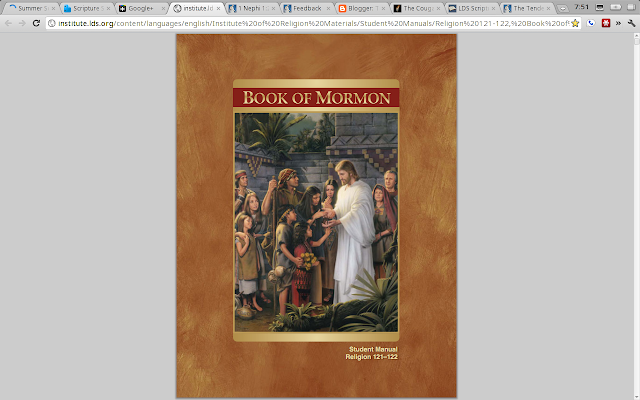
I especially recommend reading the BoM Student Manual in Google Chrome, for fast loading.
Latter-day Saints accept an open cannon of scripture and may, therefore, benefit from the inspiration and insights of modern prophets and apostles.  I love how the Book of Mormon Student Manual compiles many insights and explanations about the different verses I'm studying.  You can access even more manuals, such as for the New Testament, at institute.lds.org/eng/.

3. My Study Notebook from lds.org

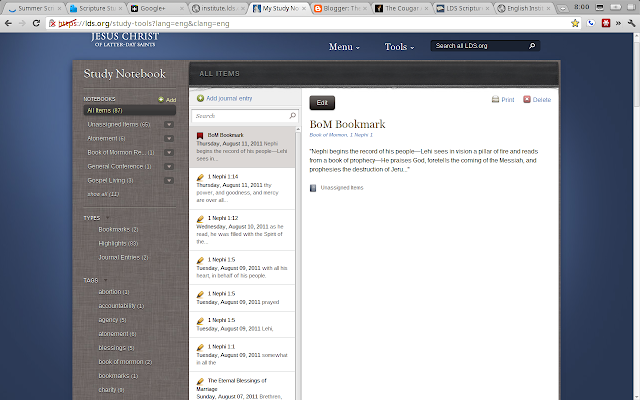
Keep track of your studies with My Study Notebook
I'll avoid going into great detail, here, and simply note what may seem obvious:  My Study Notebook helps readers with an LDS account keep track of their thoughts, highlights, bookmarks, and more.  Whenever you want to study and search the scriptures, I strongly suggest you first go to https://lds.org/study-tools?lang=eng&clang=eng because it will log you into your study notebook home page, enabling you to quickly return to your most recent reading via a bookmark, which I'll discuss next, and ensure you're keeping track of your notes and highlights while studying (otherwise, you'll have to login when you want to annotate, highlight, etc., anyway).

4. Scriptures.lds.org Bookmark Tool for Keeping My Place in My Online Study

My friendly red bookmark helps me get back to where I left off in my reading.
Now that I'm starting to read the Book of Mormon again, from the beginning, I've decided to jump in and try doing it online at scriptures.lds.org.  I'm still undecided how I feel about reading the scriptures online versus actually touching them, as they're one of the few things I generally read off my computer screen.  With that said, I've come to appreciate the bookmark feature associated with My Study Notebook.  Access it by clicking on the bookmark button in the middle-left section of the bottom toolbar.  For the moment, I believe I can set a bookmark only at the top of the page, even though I though can slide the bookmark up and down.  Maybe it's because I'm on the development channel for both Google Chrome and Chrome OS.

That's all for today!  Please share your own thoughts and suggestions in the comments section or on my plus post: https://plus.google.com/u/1/110524638589641892271/posts/gGDz8nCSwGP

Will you also please let me know what questions you have about anything you read in today's post?

Happy studying!!