Showing posts with label Book of Mormon. Show all posts

Friday, January 18, 2013

To "go no more out": A textual analysis of a catchy prhase from the Book of Mormon

This morning, I was reading in 3 Nephi 28 and came across the concluding verse, 40, where prophet-historian Mormon describes the translated status of the "Three Nephites," who are previously discussed throughout the chapter:
And in this [translated] state they were to remain until the judgment day of Christ; and at that day they were to receive a greater change, and to be received into the kingdom of the Father to go no more out, but to dwell with God eternally in the heavens.  3 Nephi 28:40
Occasionally, I read certain phrases in the Book of Mormon that really stick with me, like "the way of all the earth," which is used twice in the Old Testament, five times in the Book of Mormon, is preceded in each instance by some form of the verb "go," and refers to upcoming physical death.  Consider this death-bed rejoinder from Lehi to his wayward sons in 2 Nephi 1, for example:
Awake! and arise from the dust, and hear the words of a trembling parent, whose limbs ye must soon lay down in the cold and silent grave, from whence no traveler can return; a few more days and I go the way of all the earth.  2 Nephi 1:14
Returning to what I read this morning, I seemed to remember hearing and reading, on occasion, the first bolded phrase:  "go no more out."  It's another one of those phrases I smile about and like to throw out, myself, every now and again.  For example, perhaps after a long day I've quipped to my wife, "Honey, I'm heading home, to go no more out."

So what does the phrase mean and why am I writing about it, other than because I think it sounds cool?  Well, as with "[going] the way of all the earth," I'm convinced the phrase has a set meaning and context and gives strong circumstantial evidence of the Book of Mormon's veracity.  First, as "going the way of all the earth" is invariably associated with an impending departure from mortality (which all men and creatures experience -- "all the earth"), I believe "to go no more out" subtly refers to our pre-mortal existence with God (or Heavenly Father) and that, once reunited with Him, those who receive this gift of permanent or eternal reunion, which is "the greatest of all the gifts of God," will forever retain it, always remain with Him, never leave Him, or "go no more out" from His presence, again (as we did by coming here, to earth).

When and how is the phrase "go no more out" used in the Scriptures?  It is found five times in the Book of Mormon and only twice in the Bible, once in the Old Testament (as a brief reference to war), and once in the New Testament.  In Revelation, John writes the following about overcoming sins, trials, etc. and then living with God:
Him that overcometh will I make a pillar in the temple of my God, and he shall go no more out: and I will write upon him the name of my God, and the name of the city of my God, which is new Jerusalem, which cometh down out of heaven from my God: and I will write upon him my new name.  Revelation 3:12
Visual of scenes from the book of Revelation.
Members of The Church of Jesus Christ of Latter-day Saints (or "Mormons") often refer to the temple as "God's house" or dwelling, such as is indicated on Latter-day Saint temples, "Holiness to the LORD, the House of the LORD" and referenced by the Lord, Himself:  "And [He] said unto them that sold doves, Take these things hence; make not my Father’s house [the Jerusalem temple] an house of merchandise."  John 2:16
The temple - a recurring symbol of God's "house" and "kingdom."
A closer look at a representation of the inscription, shown in the temple picture, above.
Members of the Church and, I believe I can accurately state, believers in a Muslim-Judeo-Christian God everywhere, all refer to him as "King."  Where does a king dwell but in his house (or castle)?  Thus, the temple (which John references in Revelation) or house of God is an appropriate symbol for His dwelling, castle, and kingdom.  Unsurprisingly, the phrase "go no more out," as employed in the five distinct instances in the Book of Mormon, is always connected with God's "kingdom," which is also, as discussed, where he lives and dwells.  (Use this link for a quick overview of the five verses.)  Thus, once we return to live with God, if eligible, we will then, again, live with Him forever or "eternally," to "go no more out," as we did upon leaving His presence to come to earth.

Finally, as I set out previously (and as I have made similar submissions, in the past), I view this textual and substantive correlation to Revelation, the unique nature and consistency of the phrase, its invariable meaning (as I interpret it), and its scattering throughout the Book of Mormon as strong circumstantial evidence Joseph Smith translated a book of Scripture, revealed by God, rather than fabricating the work out of whole cloth.  The phrase "go no more out" is used twice by Alma, once by Amulek, and twice by Mormon, all sprinkled across 237 pages of text (pg. 226 - 463 in my hard copy of the Book of Mormon).
The plates of the Book of Mormon and other objects Joseph Smith found with them.
Many reject Joseph Smith's story of receiving and translating the Book of Mormon as too fantastical or whimsical.  They insist he or someone else authored the book and that his claims of receiving plates of gold, containing the scriptures he translated, are raving or, worse, fraudulent.  Given my experience of the Book of Mormon's power and immense textual richness, I conclude, by echoing the words of Elder Jeffery R. Holland (a modern-day Apostle):  "[T]hat any writer—Joseph Smith or anyone else—could create the Book of Mormon out of whole cloth would be an infinitely greater miracle than that young Joseph translated it from an ancient record ‘by the gift and power of God.’”  Jeffrey R. Holland, Christ and the New Covenant (Salt Lake City: Deseret Book, 1997), 349.  (I also highly recommend these two talks (or sermons) by Elder Holland, relating to the Book of Mormon:  Safety for the Soul and My Words Never Cease.)

Let me add my personal witness that the Book of Mormon is true.  Beyond mere neat or intriguing textual richness, I have received a witness of its truthfulness by the power of the Holy Spirit and know it is the word of God.  My ultimate purpose for writing this post is to inform you that you, also, can know this truth for yourself (see Moroni 10:3-5).

Sunday, January 13, 2013

Broncos, Seahawks, and Perspective

In the words of Anton Ego, "After reading a lot of overheated puffery about your [teams], you know what I'm craving? A little perspective. That's it. I'd like some fresh, clear, well seasoned perspective."

File:Denver Broncos logo.svg

In light of the Broncos' and Seahawks' losses, I have very little I want to say, other than I appreciate this time to remember what really matters and who is truly trustworthy.  (For a pretty solid and depressing breakdown of the Broncos' losses, see this article from Woody Paige.)

Yes, Peyton Manning is an awesome quarterback, yet even he can create devastating turnovers.  Yes, the Broncos' defense is tremendous (is it still?), yet even it can be embarrassed and humiliated in a huge game.

Can sports be gratifying?  Certainly.  Where would we do best to put our trust (and our happiness)?  "O Lord, I have trusted in thee, and I will trust in thee forever. I will not put my trust in the arm of flesh; for I know that cursed is he that putteth his trust in the arm of flesh. Yea, cursed is he that putteth his trust in man or maketh flesh his arm."  2 Nephi 4:34.

May Peyton Manning's throwing arm retain its strength . . .

Wednesday, August 22, 2012

War in the Book of Mormon

Recently, I've been reading from the "war chapters," found in the book of Alma in the Book of Mormon.

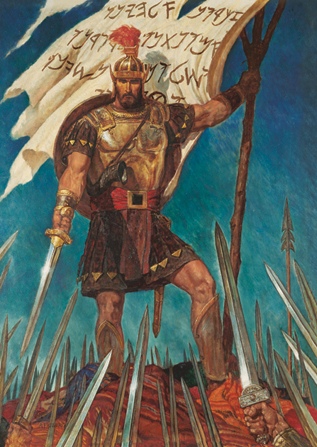
Read about Moroni and the "title of liberty" he raised:
"In memory of our God, our religion, and freedom, and our peace, our wives, and our children"
In the Church of Jesus Christ of Latter-day Saints, we witness that "[the Book of Mormon] does not merely claim to be a moral treatise or theological commentary or collection of insightful writings. It claims to be the word of God—every sentence, every verse, every page."

If every part of this book claims to be the word of God, why is there so much discussion of war, in general and, occasionally, certain wars, in particular?  I did some research, this morning, and found an article from Richard Dilworth Rust, addressing the topic.  Here is an excerpt:
Who will fight the battles for the "true worshipers of Christ"? Ultimately, God: "I will show unto them that fight against my word and against my people, who are of the house of Israel, that I am God, and that I covenanted with Abraham that I would remember his seed forever" (2 Nephi 29:14).
What, then, does the Book of Mormon do concerning this latter-day warfare? It shows the fundamental nature of the battle and gives hope to the Lord's people. With accounts of the victories of small minorities against overwhelming odds (often with no lives of the righteous being lost) or of escapes from their enemies (as with the people of Lehi, Nephi, Mosiah, Alma the elder, and Limhi), it confirms the truth . . ., "God will provide strength for the righteous and the means of escape."
I strongly suggest you read the full article (pretty quick read, maybe 5-10 minutes). I think you'll really enjoy it.

Let me add some likely duplicative insights of my own:  Rarely does the Book of Mormon give a blow-by-blow description of things such as army formations or granular tactics in battles or wars.  Instead, they are almost always spoken of in generalities and illustrate the power of God in delivering His people.  As the book's first prophet-writer explained of his own purpose in writing, "I, Nephi, will show unto you that the tender mercies of the Lord are over all those whom he hath chosen, because of their faith, to make them mighty even unto the power of deliverance."  1 Nephi 1:20.  I believe the prophet-historian-abridger Mormon and other writers often illustrate this concept and promise in the Book of Mormon through examples of war.

Let me conclude by adding my witness that the Book of Mormon is what it claims to be.  It is the word of God, "every sentence, every verse, every page."  I know this is true because I have received confirmation of it from the quiet assurances of the Holy Spirit, and so can all who sincerely ask.

Saturday, August 18, 2012

Taking Offense

"Woe unto the world because of offences! for it must needs be that offences come; but woe to that man by whom the offence cometh!"  Matthew 18:7.

This message is for me, as much as it is for anyone who reads this.

This morning, I read the following from the Book of Mormon student manual, pg. 259, Alma 60:19–36. Moroni’s Letter to Pahoran:


Pahoran could have chosen to be offended by the letters sent by Moroni, but he did not. Elder David A. Bednar of the Quorum of the Twelve Apostles described the fact that we, like Pahoran, can choose to not be offended:

Elder David A. Bednar
“When we believe or say that we have been offended, we usually mean we feel insulted, mistreated, snubbed, or disrespected. And certainly clumsy, embarrassing, unprincipled, and mean-spirited things do occur in our interactions with other people that would allow us to take offense. However, it ultimately is impossible for another person to offend you or to offend me. Indeed, believing that another person offended us is fundamentally false. To be offended is a choice we make; it is not a condition inflicted or imposed upon us by someone or something else. . . . 

“Through the strengthening power of the Atonement of Jesus Christ, you and I can be blessed to avoid and triumph over offense. ‘Great peace have they which love thy law: and nothing shall offend them’ (Psalm 119:165). . . . 

“. . . As described by Elder Neal A. Maxwell, the Church is not ‘a well-provisioned rest home for the already perfected’ (in Conference Report, Apr. 1982, 57; or Ensign, May 1982, 38). Rather, the Church is a learning laboratory and a workshop in which we gain experience as we practice on each other in the ongoing process of ‘perfecting the Saints.’ 

“Elder Maxwell also insightfully explained that in this latter-day learning laboratory known as the restored Church, the members constitute the ‘clinical material’ (see ‘Jesus, the Perfect Mentor,’ Ensign, Feb. 2001, 13) that is essential for growth and development. . . . 

“You and I cannot control the intentions or behavior of other people. However, we do determine how we will act. Please remember that you and I are agents endowed with moral agency, and we can choose not to be offended” (in Conference Report, Oct. 2006, 95–97; or Ensign, Nov. 2006, 90–91).


I hope you enjoyed that as much as I did.  I think you will also love this talk by Elder Neil L. Andersen, given in October 2010.

Tuesday, May 22, 2012

"Our Great God": Simple Evidences of the Book of Mormon's Authenticity

Update:  I came across another insight this morning that I think you'll enjoy.  In the Book of Mormon, the phrase "redeeming love" is used only three times.  In every instance, it refers to the "song" of redeeming love or "singing" redeeming love and is spoken of by two contemporaries, Alma and Ammon.  Again, what remarkable, sophisticated, and unique character and background development for a mere (yet incredibly scheming and conniving(?)) farm boy!  [end update]

Some people disregard the Book of Mormon because they insist upon seeing the gold plates from which it was translated.  In reality, 11 people did see the plates and gave their names as a witness to the world that they saw them.  Of these witness, though many were excommunicated and some became very hostile to Joseph Smith, none of them ever denied what they saw.

As I have read and pondered the Book of Mormon, again and again and prayed to know its truthfulness, I have relished one challenge in particular:  On every page, the reader is asked to question whether Joseph Smith merely made up what's on the page or whether he actually translated it through the power and authority of God.

The other day, I came across such an instance I'd like to share with you:  Character development.

The Prophet Joseph Smith received little more formal education than an elementary school student, or perhaps even less.  In spite of this deficiency, he translated a work of 531 pages via dictation in only sixty-five to seventy-five days(!) (How Long Did It Take to Translate the Book of Mormon?).

Setting aside the Book of Mormon's length, the sincere reader is invited to consider its content, which brings us to the thrust of this post:  Unique individuals have unique manners of speaking.  Some speak with an accent or use characteristic words or phrases.  The other day, I came across the latter while reading in Alma 24.

In this chapter, a people who had violently opposed another (the Lamanites opposing the Nephites) for many years, accepted the doctrine of Christ and repented of their sins.  As part of their sincere repentance, they decided to physically bury their weapons of war, deep in the earth, as a witness of their conversion and sincerity (illustrated below).

The king of this group, in encouraging his people to bury their weapons, gave an uplifting sermon, and used the unique phrase "great God" five times in only eight verses.  I thought about how often I'd read that phrase in the Book of Mormon and performed a search of "great god" to check.  The search returned only five hits in all 531 pages of the Book of Mormon -- all five instances spoken by this same king, in a span of eight verses.

I was astounded.  I assumed this would be a more common phrase in a book that uses the word "God" in something around 1,300 verses.  What an ingenious touch from a mere farm boy!  Right?

The Lamanites burying their weapons of war as a witness of their repentance.
I leave you with another challenge, given by the late Hugh B. Brown:
I believe the Prophet Joseph Smith was a prophet because he did many superhuman things. One was translating the Book of Mormon. Some people will not agree, but I submit to you that the Prophet Joseph Smith in translating the Book of Mormon did a superhuman work. I ask you … to undertake to write a story on the ancient inhabitants of America. Write as he did without any source of material. Include in your story 54 chapters dealing with wars, 21 historical chapters, 55 chapters on visions and prophecies, and, remember, when you begin to write on visions and prophecies you must have your record agree meticulously with the Bible. You write 71 chapters on doctrine and exhortation, and, here too, you must check every statement with the scriptures or you will be proven to be a fraud. You must write 21 chapters on the ministry of Christ, and everything you claim He said and did and every testimony you write in your book about Him must agree absolutely with the New Testament. 
I ask you, would you like to undertake such a task? I would suggest to you too that you must employ figures of speech, similes, metaphors, narrations, exposition, description, oratory, epic, lyric, logic, and parables. Undertake that, will you? I ask you to remember that the man that translated the Book of Mormon was a young man who hadn’t had the opportunity of schooling that you have had, and yet he dictated that book in just over two months and made very few, if any, corrections. For over 100 years, some of the best students and scholars of the world have been trying to prove from the Bible that the Book of Mormon is false, but not one of them has been able to prove that anything he wrote was not in strict harmony with the scriptures. …

Sunday, April 8, 2012

Today's Spiritual Message: Happy Easter!

Cross-posted from my Google+ account:

On this Easter Sunday, I would like to share my brief witness of Christ's divinity and His centrality to our post-mortal life:

For as in Adam all die, even so in Christ shall all be made alive. 1 Cor. 15:22

If in this life only we have hope in Christ, we are of all men most miserable. 1 Cor. 15:19

And [Christ] suffereth [the pains of all] that the resurrection might pass upon all men, that all might stand before him at the great and judgment day. 2 Nephi 9:22

Behold, I am Jesus Christ, the Son of God. I am the life and the light of the world. Doctrine & Covenants 11:28

I know these scriptures are true and that Jesus Christ is who He said He was: our Savior and Redeemer, the author of our salvation and the resurrection of all people.

Please join the discussion at mormon.org/easter and learn more about the resurrection at http://www.lds.org/scriptures/gs/resurrection.p4?lang=eng&letter=r


Sunday, November 20, 2011

Today's Spiritual Message: Eastern European Youths Discuss Their Experience with the Book of Mormon

A number of young people (I assume members of the Church of Jesus Christ of Latter-day Saints) accepted the challenge to read from the Book of Mormon for 20 minutes each day.  Below, they share their experience.

Sunday, November 6, 2011

Today's Spiritual Message: A Book of Mormon Story

I hope you enjoy today's spiritual message about an English bishop from Jamaica's experience with the Book of Mormon.

Sunday, August 21, 2011

Today's Spiritual Message: The Blessings of Scripture

My family and I read a scripture in 2 Nephi, the other day, that I feel closely applies to today's message:
Their land is also full of idols; they worship the work of their own hands, that which their own fingers have made.  (2 Nephi 12:8.)
I am amazed and saddened with how much we, as humans, currently glory in our own intelligence and learning, often, to the point of extolling ourselves for how much more advanced we are than our lowly forebears.

Ironically,
scriptural ignorance [previously] abounded because people lacked access to the Bible, especially in a language they could understand. Today the Bible and other scripture are readily at hand, yet there is a growing scriptural illiteracy because people will not open the books. Consequently they have forgotten things their grandparents knew.
I am so grateful for William Tyndale and other scriptural martyrs, who made it possible for us to have (in English) the volumes of scripture we so often take for granted, today.  What a marvelous blessing the scriptures have been in my life.


To learn more about the scriptures and what modern prophets and apostles have said about them, I invite you to visit lds.org page where I originally found this video and click on its various, surrounding links.

Sunday, August 14, 2011

Today's Spiritual Message: The Book of Mormon (Scripture)

You may have heard about the Book of Mormon Musical on Broadway.  To my knowledge, it tracks a couple of missionaries from the Church of Jesus Christ of Latter-day Saints ("Mormons"), as they encounter difficulty, trial, and, to put it gently, a whole lot of "stuff," in Africa . . .  So what about the book that shares the musical's name?  I love the Church's official response to the musical:
The production may attempt to entertain audiences for an evening, but The Book of Mormon as a volume of scripture will change people's lives forever by bringing them closer to Christ.
—Official Church Statement on the Book of Mormon Musical
And so it does.


And now, behold, I will testify unto you of myself that these things are true. Behold, I say unto you, that I do know that Christ shall come among the children of men, to take upon him the transgressions of his people, and that he shall atone for the sins of the world; for the Lord God hath spoken it.  (Alma 34:8)
And I said unto him: Believest thou the scriptures? And he said, Yea.  And I said unto him: Then ye do not understand them; for they truly testify of Christ. Behold, I say unto you that none of the prophets have written, nor prophesied, save they have spoken concerning this Christ.  (Jacob 7:10-11)
I add my testimony to those of Amulek, Jacob, and so many Book of Mormon prophets that Jesus is the Christ, the One sent to suffer and atone for our sins.  I also testify that the Book of Mormon is the word of God and another testament of Jesus Christ.  I invite you to gain this own witness for yourself, by following the  instructions given in Moroni 10:3-5.  I add my promise to Moroni's that if you will ask God with a sincere heart and real intent -- meaning you are willing to act on the answer you receive -- you will come to know by the power of the Holy Ghost that the Book of Mormon is true.

To learn more about the Book of Mormon, its power and witness of Christ, along with its origins, I invite you to visit http://mormon.org/book-of-mormon/.  To learn more about how the Book of Mormon has impacted my own life, I invite you to click on the image, at the right, that says "I'm a Mormon . . ." (beneath the heading, "My Mormon.org Profile").

As always, please feel free to share your thoughts, questions, and comments, below.